

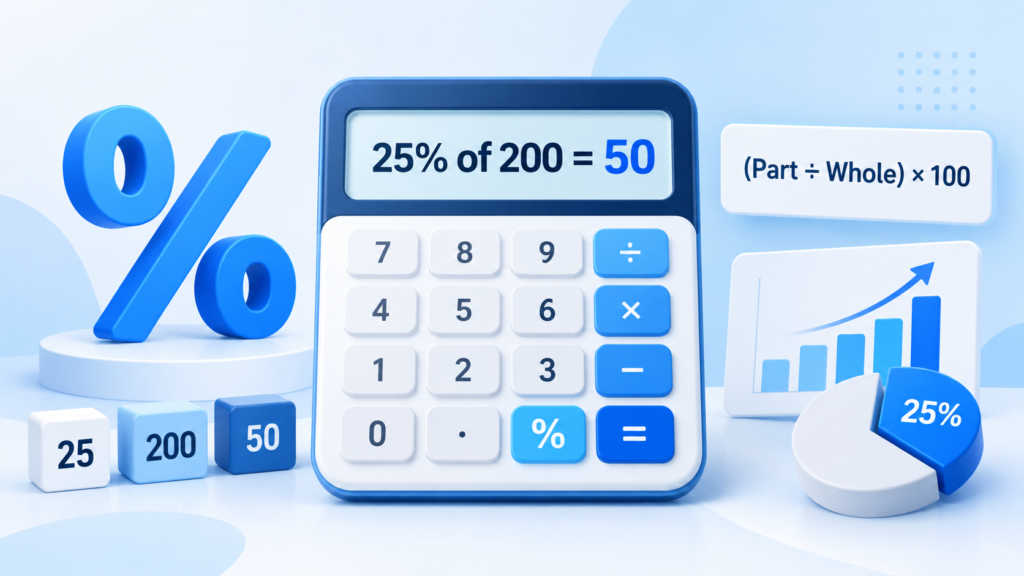
How to Calculate Percentage: Formula, Examples & Easy Methods
Percentages appear everywhere—from exam marks and shopping discounts to salary increases, taxes, business reports, and everyday comparisons. Yet it is easy to get confused about which numbers to divide, multiply, or subtract. If you want to know how to calculate percentage, the basic idea is simple: compare a value with a total and multiply the result by 100. However, different situations require slightly different formulas. This guide explains the percentage formula step by step, with practical percentage examples covering marks, discounts, increases, decreases, fractions, and more. You will also learn when a percentage calculator can make the process faster. What Is a Percentage? A percentage represents a number or quantity as a fraction of 100. The word “percent” essentially means “per hundred.” For example: The percentage symbol is %. Percentages make it easier to compare values that have different totals. For instance, a student scoring 40 out of 50 and another scoring 72 out of 90 both scored 80%, making their performance easier to compare. How to Calculate Percentage Using the Basic Formula The standard percentage formula is: Percentage = (Value ÷ Total Value) × 100 In other words: Percentage = (Part ÷ Whole) × 100 To calculate percentage, follow these three steps: Simple Percentage Example Suppose you answered 45 questions correctly out of 60. Use the formula: Percentage = (45 ÷ 60) × 100 Percentage = 0.75 × 100 Percentage = 75% Therefore, 45 out of 60 is 75%. This same method works for marks, survey results, sales figures, completed tasks, attendance, and many other situations. How to Calculate Percentage of a Number Sometimes you already know the percentage and need to find its value. Use this formula: Value = (Percentage ÷ 100) × Number For example, what is 20% of 250? 20% of 250 = (20 ÷ 100) × 250 = 0.20 × 250 = 50 So, 20% of 250 is 50. More Percentage Examples Question Calculation Answer 10% of 500 (10 ÷ 100) × 500 50 25% of 200 (25 ÷ 100) × 200 50 50% of 80 (50 ÷ 100) × 80 40 75% of 120 (75 ÷ 100) × 120 90 5% of 600 (5 ÷ 100) × 600 30 A percentage calculator is useful when the numbers involve decimals or when you need to perform several calculations quickly. How to Find What Percentage One Number Is of Another Another common question is: “What percentage is X of Y?” Use: Percentage = (First Number ÷ Second Number) × 100 Suppose you want to know what percentage 30 is of 120. Percentage = (30 ÷ 120) × 100 = 0.25 × 100 = 25% Therefore, 30 is 25% of 120. The order matters. Asking “What percentage is 30 of 120?” is different from asking “What percentage is 120 of 30?” For the second question: (120 ÷ 30) × 100 = 400% Always identify which number represents the part and which represents the whole before applying the percentage formula. How to Calculate Percentage Increase Percentage increase tells you how much a value has grown relative to its original value. Use this formula: Percentage Increase = ((New Value − Original Value) ÷ Original Value) × 100 Example: Salary Increase Suppose a monthly salary increases from ₹40,000 to ₹46,000. First, find the increase: ₹46,000 − ₹40,000 = ₹6,000 Then divide the increase by the original salary: ₹6,000 ÷ ₹40,000 = 0.15 Multiply by 100: 0.15 × 100 = 15% The salary increased by 15%. Notice that the denominator is the original value, not the new value. Using the wrong denominator is one of the most common mistakes when people calculate percentage change. How to Calculate Percentage Decrease Percentage decrease measures how much a value has fallen compared with its original amount. The formula is: Percentage Decrease = ((Original Value − New Value) ÷ Original Value) × 100 Example: Price Reduction Suppose the price of a product falls from ₹2,000 to ₹1,600. Find the decrease: ₹2,000 − ₹1,600 = ₹400 Divide by the original price: ₹400 ÷ ₹2,000 = 0.20 Multiply by 100: 0.20 × 100 = 20% The price decreased by 20%. Percentage Increase vs. Percentage Decrease The two calculations are closely related, but the direction of change is different. Calculation Formula Purpose Basic percentage (Part ÷ Whole) × 100 Find what portion of a total something represents Percentage increase ((New − Original) ÷ Original) × 100 Measure growth Percentage decrease ((Original − New) ÷ Original) × 100 Measure reduction Percentage of a number (Percentage ÷ 100) × Number Find a specified percentage of a value The original value is especially important when calculating increases and decreases. How to Calculate Percentage Change Percentage change is a general way to measure the difference between an old value and a new value relative to the original. Use: Percentage Change = ((New Value − Old Value) ÷ Old Value) × 100 A positive result indicates an increase, while a negative result indicates a decrease. Example Suppose monthly website visits change from 8,000 to 10,000. ((10,000 − 8,000) ÷ 8,000) × 100 = (2,000 ÷ 8,000) × 100 = 25% Traffic increased by 25%. If visits instead dropped from 8,000 to 6,000: ((6,000 − 8,000) ÷ 8,000) × 100 = −25% The negative sign indicates a 25% decrease. How to Calculate Percentage Difference Percentage change and percentage difference are not always the same thing. Percentage change compares a new value with an original or reference value. Percentage difference is useful when comparing two values and neither is naturally considered the starting value. A common formula is: Percentage Difference = (|Value 1 − Value 2| ÷ ((Value 1 + Value 2) ÷ 2)) × 100 The vertical bars mean that you use the absolute difference, so the numerator is positive. Example Compare 80 and 100. Difference: 100 − 80 = 20 Average: (80 + 100) ÷ 2 = 90 Percentage difference: (20 ÷ 90) × 100 ≈ 22.22% The percentage difference is approximately 22.22%. How to Calculate Marks Percentage Students frequently need to